Nobody chooses impact windows because they enjoy paperwork, but the paperwork is what makes the protection count. Design pressure, wind-borne debris maps, Florida Product Approval, Miami-Dade notices, permits and inspections all decide whether your new glass is compliant, creditable and defensible. Here is what really governs a window job around Spring Hill.
The Florida Building Code Sets the Rules
One Statewide Code, Local Enforcement
Florida is unusual in having a single statewide building code instead of a patchwork of city ordinances. The Florida Building Code, Residential governs window replacement everywhere in the state, and it is updated on a multi-year cycle, so the edition in force when your permit is issued is the edition your job is judged against. Enforcement, however, is local. In Spring Hill and unincorporated Hernando County that means the county building division, a Brooksville address goes through the city, and homes in Hudson or New Port Richey go through Pasco County. Those offices apply the same code but differ in submittal formats, fees, review times and inspection scheduling. The technical requirements for your windows do not change if you move one county south, but the paperwork and the queue do.
Wind-Borne Debris Regions and Your Address
The code assigns every location an ultimate design wind speed, and areas above a threshold are designated wind-borne debris regions where glazed openings must be impact resistant or protected. Much of Florida's Gulf-facing territory lies inside one, and the requirement generally tightens as you get closer to open water. A house in Hernando Beach or out toward Weeki Wachee sits in a more demanding exposure than one tucked into a built-up subdivision several miles inland. This is decided by mapped criteria for your specific parcel rather than by a rule of thumb, which is why a proposal should state the wind speed and exposure category it was designed around. Two houses on the same street can differ if one faces open ground and the other is shielded on every side.
Design Pressure Without the Math
Design pressure is the load a window has to survive, expressed as a positive number for wind pushing in and a negative number for wind pulling out. It is calculated opening by opening from the wind speed, the building height and exposure, and where the opening sits, because corners and edges take noticeably higher suction than the middle of a wall. Larger openings generally need higher-rated construction than small ones. Every approved window carries rated pressures on its label and in its approval document, and compliance simply means the rated numbers meet or exceed the calculated requirement for that opening. When a proposal lists one pressure rating for an entire house, that is a sign nobody ran the openings individually.
Product Approval: Two Paths to the Same Place
Florida Product Approval
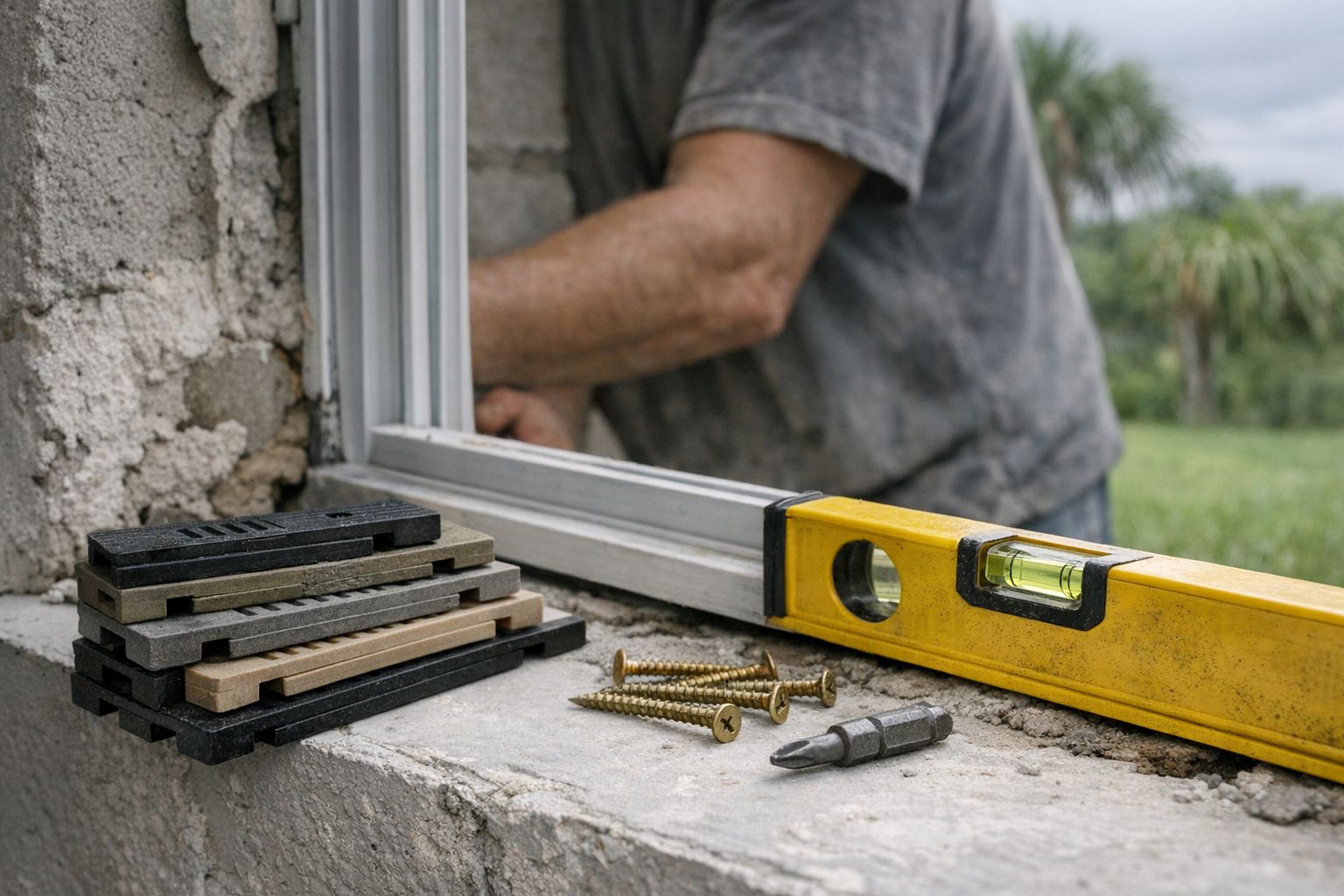
Statewide Florida Product Approval is the common route. A manufacturer has an assembly tested by an accredited laboratory, has the results evaluated, and receives a numbered approval spelling out the sizes permitted, the pressures earned, the impact rating and the exact installation methods allowed, including fastener type, size, embedment and spacing into concrete block or a wood buck. That last part is what people miss. An approval is not a blanket endorsement of the window; it is a permission slip that holds only if the unit is installed within the sizes and methods it lists. The approval number belongs in the permit package, and the installation detail used on your house should come out of that document rather than out of a crew's habit.
Miami-Dade Notice of Acceptance
A Miami-Dade Notice of Acceptance, or NOA, is issued through that county's own product control process, and it is widely treated as the strictest approval in the state because the High Velocity Hurricane Zone protocols are more demanding. NOA-approved units are accepted well outside South Florida and are often specified in areas that do not require them, either for margin or for insurance reasons. It is worth being clear about what that buys. Outside the high velocity zone, a Florida Product Approval rated for your calculated design pressure is fully compliant, and an NOA unit does not rescue a poorly anchored installation. Either label is legitimate. What matters is that a label exists, that the numbers cover your opening, and that the anchoring matches the document.
Impact window installation — Spring Hill, FL
What the Permit and Inspection Cover
The Application and the Anchor Detail
A window permit application is more than a fee. It typically includes a schedule of openings with sizes, the product approval or NOA number for each unit, the rated pressures set against the required pressures, and an installation detail showing how each unit attaches to stucco over concrete block or to a wood buck. Reviewers check that the products are current, that the ratings cover the openings and that the anchoring comes from the approval. The permit is normally pulled by the contractor performing the work, and the property owner should be able to see it. If anyone suggests skipping the permit to save time or money, understand what is being skipped: the only independent check that the assembly on your wall matches the assembly that passed the test.
Inspection Day and the Closed Permit
Inspection is where the detail gets verified. An inspector confirms the installed units match the permitted products, looks at fastener type and spacing, checks that anchors land in sound masonry at proper embedment rather than in stucco alone, and reviews sealing and flashing at the sill so water drains outward. Manufacturer labels are usually expected to stay on the glass or frame until after the inspection, which is why crews leave those stickers in place. When the work passes, the permit is closed, and that closure is the record that the job met code. An open or expired permit follows the property instead of the contractor. It surfaces at sale, and clearing it later can mean opening finished walls to prove what is behind them.
HOA Rules and Coastal Realities
Architectural Review Runs in Parallel
A homeowners association cannot waive the building code, and the building department does not enforce association rules; the two run on separate tracks and you may need to clear both. Many Spring Hill and Pasco communities restrict frame color, grid or muntin pattern, glass tint and whether an opening's operating style may change, and some require approval before work starts even for a like-for-like replacement. Turning a bank of single-hung units into a fixed picture window, or moving from white to bronze frames, is the kind of change that gets flagged after installation when it was never submitted. Ask for the architectural guidelines in writing, submit product cut sheets with the request, and file the approval letter alongside the permit paperwork.
Salt Air, Surge Zones and Exposure
Proximity to the Gulf changes what holds up over time. Salt air accelerates corrosion on fasteners, balances and locks, so stainless hardware and appropriate finishes are worth specifying on homes in Hernando Beach, Homosassa and Hudson, not only on the waterfront. Storm surge is a separate hazard from wind and is governed by flood provisions rather than by glazing ratings. An impact window is not a flood barrier, and a home in a surge zone may face requirements about elevation, flood openings and materials below the design flood elevation that have nothing to do with the windows. If the parcel sits in a mapped flood zone, ask the building department how those provisions interact with the scope before you sign, since it can affect both sequencing and cost.
Why the Label Matters Long After Installation
Wind Mitigation and Claim Time
A Florida wind mitigation inspection asks a specific set of questions, and one of them is whether all glazed openings are protected to the required standard. The inspector wants evidence: approval numbers, visible labels, or a closed permit tying the units to a tested product. Without that, protection you paid for may go uncredited, because from the carrier's side an unlabeled window is an unknown window. The same logic applies after a storm. When a claim is filed, records showing permitted, code-compliant openings remove an entire category of argument about whether the installation contributed to the damage. Keeping the paperwork costs nothing. Reconstructing it years later, after a manufacturer has revised or retired a product line, often is not so easy.
Resale, Appraisal and the Document Folder
At sale, impact glass draws attention, and the buyer's inspector will look at the permit history on the property. Records showing permitted work closed out let a buyer and their insurer price the home with the protection counted, while unpermitted window work invites a repair request, an escrow holdback or a retroactive permit process at the seller's expense. Build the folder while the job is fresh: the signed proposal, the product approval or NOA number for each opening, the permit, the inspection record, photographs of the labels before they came off, and the warranty registration for the units. Questions about what your own address requires are worth asking before a contract is signed. Call (352) 309-3256 to walk through the code and permit path for your home.
Ready for Impact Windows?
Get a free on-site estimate from Spring Hill's impact window specialists. Permitted and inspected.
📞 Call (352) 309-3256